Manufacturing
Cellectis operates fully integrated GMP manufacturing facilities that provide the Company with control, flexibility and expertise across the development and production of advanced genetic medicines
Our manufacturing infrastructure supports the production of critical genome engineering components, including plasmid DNA, mRNA and other materials required for the development of innovative therapeutic approaches.
These capabilities support ongoing partnered programs and provide Cellectis with valuable manufacturing expertise, operational flexibility and quality control across advanced genetic medicine development.
By maintaining in-house manufacturing expertise, Cellectis benefits from greater control over quality, timelines and technology transfer, helping accelerate development and ensure reliable execution.
Our process – powered by TALEN® and our proprietary PulseAgile electroporation technologies – inactivates targeted genes in a highly efficient and precise manner that avoids harming T-cells during processing. As a result, we can manufacture quality UCART products with high yields.
Cellectis controls its gene and cell therapy process from start to finish. We are capable of moving an innovative new idea from innovation to development, manufacturing, clinical trials, and delivery directly to the patient – all in-house.
Having our internalized manufacturing ensures clinical program timelines can be readily met with drug product supply so patients are never waiting to be treated.

Cellectis New York
Platform Innovation & Clinical Development
- Genome engineering platform – TALEN® , TALEB, TALEM
- CAR T discovery
- In vivo gene therapy discovery
- Clinical development

Cellectis GMP Paris
CMC Development, Starting Materials
- Cryogenic storage rooms
- Process & analytical development
- Starting materials (plasmids, mRNAs, viral vectors)
- Manufacturing and QC testing site

Cellectis GMP Raleigh
UCART – Clinical & Intended Commercial Site
- Cryogenic storage rooms
- UCART GMP manufacturing and QC labs
Manufacturing process
-
Step 1: Frozen Leukopaks
Blood is drawn from pre-selected donors. Red blood cells and platelets are filtered out leaving only the white blood cells or Peripheral Blood Mononuclear Cells (PBMCs) behind. This is then put into freezer bags which we call leukopaks.
-
Step 2: Thawed PBMCS
The manufacturing process begins by thawing the frozen cells and selectively activating the T-cells.
-
Step 3: Lentivector Transduction
Chimeric antigen receptors (CAR) are engineered receptors that allow cells to bind to specific proteins. These are added to the T-cells with the help of lentiviral vector transduction, a virus-derived tool used to penetrate cells.
-
Step 4: TALEN-Mediated Gene Editing
Our proprietary Pulse Agile electroporation technology uses precise electrical pulses to create temporary pores in the CAR T-cells that make them permeable. This allows us to introduce the TALEN® (transcription activator-like effector nucleases), which are enzymes that have been engineered to cut specific sequences of DNA. As an example, a precise edit is made that eliminates the T-cell receptor (TCR). This is an important step since the TCR would normally trigger a rejection response from the patient’s immune system since the cells come from donors. Knock-outs of more than one gene are possible with our technologies.
-
Step 5: Cell Expansion
The population of gene-edited CAR T-cells is amplified using automated processes and special tools called bioreactors. This part of the process is also referred to as cell expansion.
-
Step 6: Purification
Gene-edited CAR T-cells are sorted and selected through our purification processes.
-
Step 7: Fill and Finish
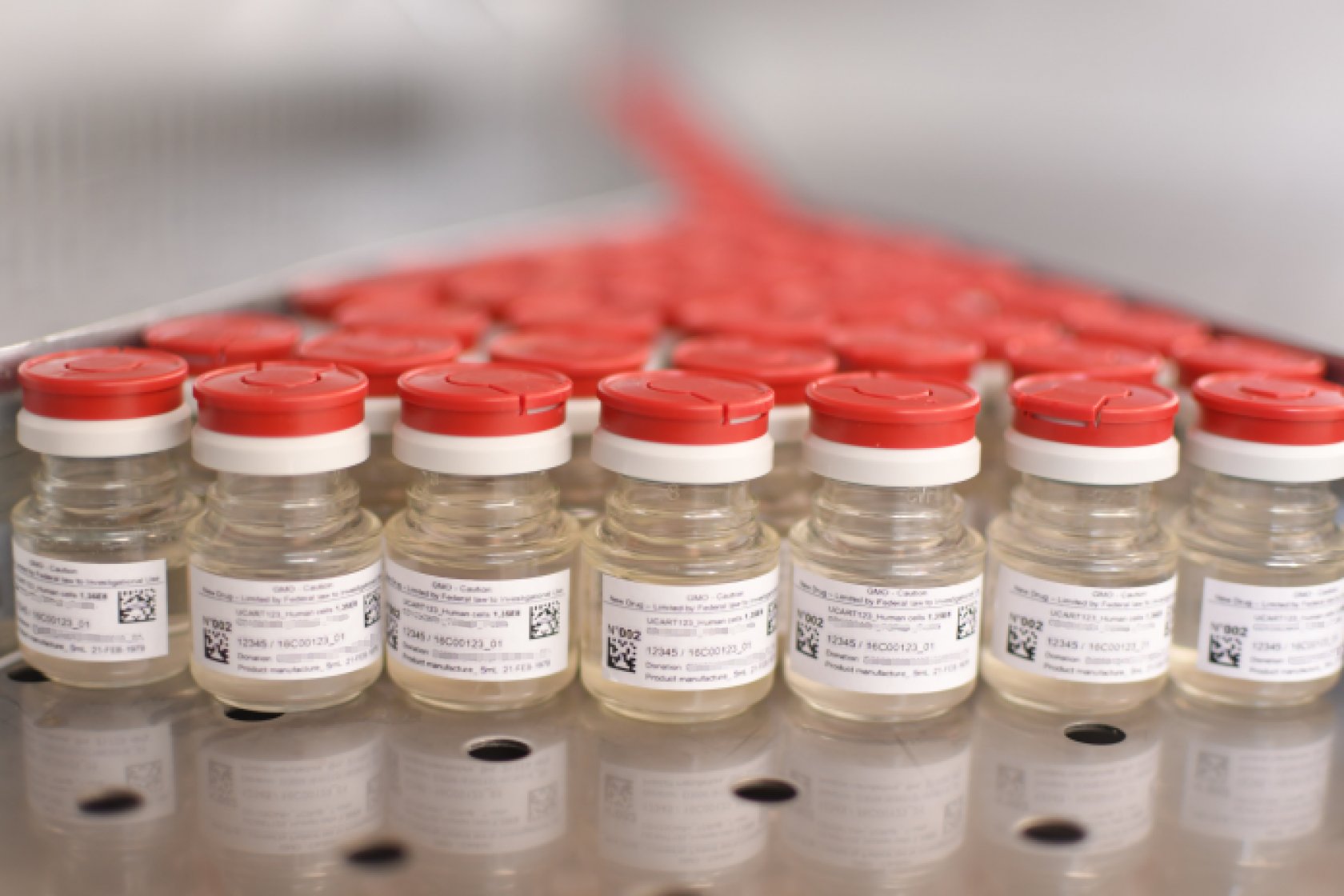
Vials are filled with our allogeneic UCART product candidates. The formulation includes a cryopreservation medium, which allows the cells to be preserved at very low temperatures for an extended shelf-life.
-
Step 8: Frozen UCART Product
The vials are frozen and packaged so that they can be safely shipped to hospitals for administration to patients.
Quality control checks are done all throughout the manufacturing process (in-process controls). These continuously assess the UCART product candidates on four key attributes: identity, safety, strength and stability.